Not long ago, identifying a rock meant flipping through field guides, comparing streak colors and hoping an expert on a forum would reply. Today, photo rock identification does the heavy lifting: AI trained on thousands of mineral specimens can match your picture against known rocks, minerals and crystals almost instantly.
Can you really identify a rock from a picture?
Yes — with the right photo. A rock's visual fingerprint includes its color, luster (how it reflects light), texture, grain size, transparency and crystal shape. AI identification reads all of these at once and compares them across a huge reference library, something no human can do at a glance. For common finds like quartz, granite, obsidian, calcite, agate or pyrite, a good photo is usually all it takes.
How to take a photo that gets an accurate ID
- Use natural, indirect light. Harsh flash washes out color and hides luster — daylight near a window works best.
- Get close and sharp. Fill the frame with the rock. Blurry photos are the #1 cause of wrong IDs.
- Show a fresh surface if possible. Weathered crusts can hide the true mineral underneath.
- Use a neutral background. Your palm or a plain table beats a busy patterned surface.
- Capture the details. Crystal faces, banding, and fracture surfaces are highly diagnostic — zoom in on them.
Identify a rock by picture with Mineral Identifier AI
- Download Mineral Identifier AI free on your iPhone or iPad.
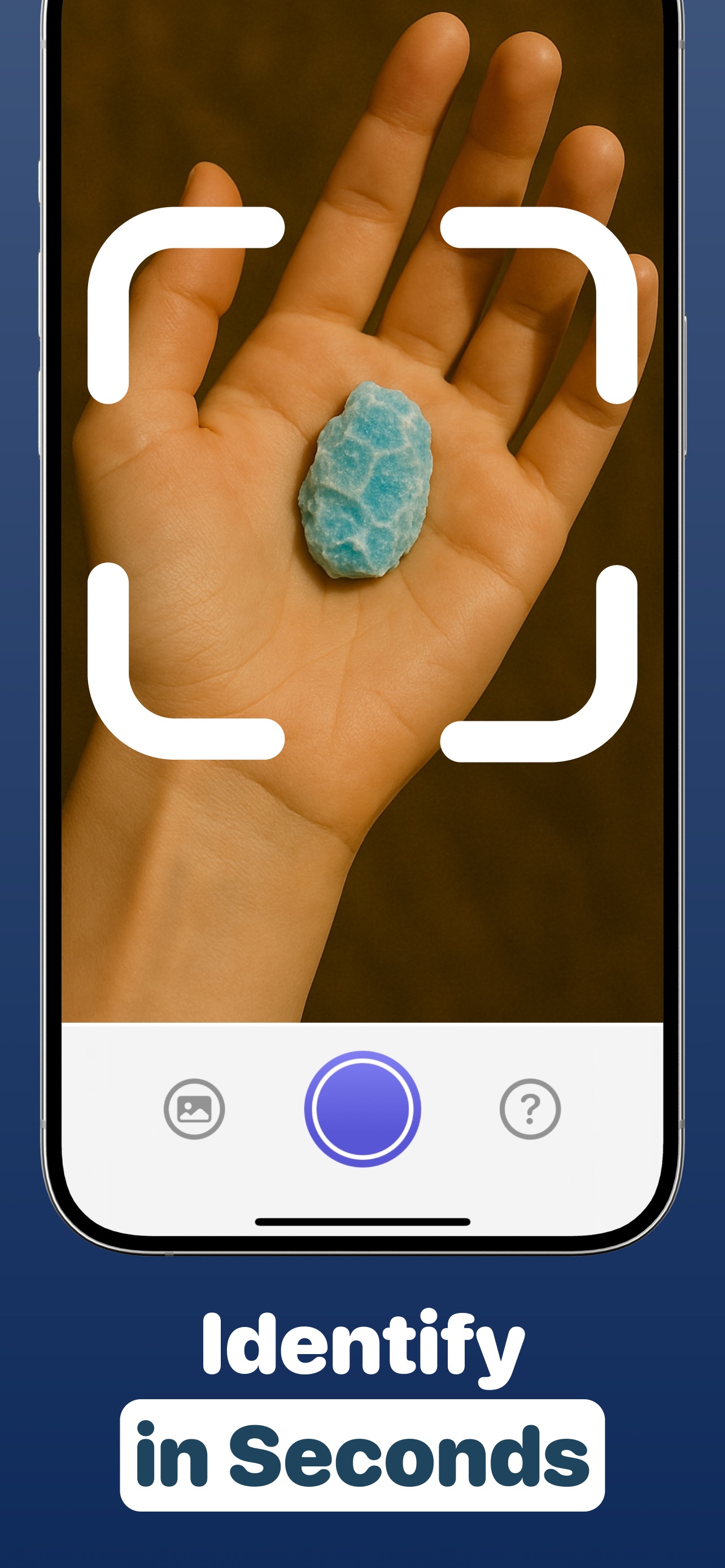
- Tap the camera button and point it at your rock — or upload an existing photo from your library.
- Use the built-in zoom to frame fine details like crystal faces or banding.
- Get your result in seconds: mineral name, chemical formula, classification, Mohs hardness and color.
- Go deeper: check the estimated market value, read the stone's lore, or ask Rocksy — the app's AI assistant — any follow-up question.
What you'll learn about your rock
A photo ID in Mineral Identifier AI doesn't stop at a name. Every result includes the chemical composition (like SiO₂·nH₂O for opal), hardness on the Mohs scale, crystal system, cleavage and fracture, plus an estimated market value — so you immediately know whether you're holding a keeper. There's even a "Legend & Lore" section covering mythology and healing traditions for every stone.
When a picture isn't enough
Some minerals are visual twins — real gold and pyrite, or clear quartz and topaz. If the app flags something potentially valuable, treat the result as a strong first opinion: check the listed hardness against a simple scratch test, and for high-value finds, confirm with a local gem society or professional appraiser. For everyday rockhounding, though, a photo ID is the fastest tool ever put in a collector's pocket.