Every collector has asked it: "how much is my rock worth?" The honest answer is that value depends on what the rock is — and that's exactly the problem. You can't price a specimen until you've identified it. That's why the fastest route to a realistic number is an ID and a value estimate in the same scan.
What makes a rock or mineral valuable?
- Species and variety. An opal and a piece of common chalcedony can look similar to a beginner — and differ in value by a factor of a hundred.
- Color and play-of-color. Vivid, saturated color commands a premium; opal's rainbow flash or fine amethyst's deep purple can multiply the price.
- Crystal quality. Sharp, undamaged, well-formed crystals are worth far more than broken fragments of the same mineral.
- Size and weight. Prices climb non-linearly — a specimen twice as large can be worth several times more.
- Rarity and locality. Some minerals are only found in a handful of places; a documented locality (like Larimar from the Dominican Republic) adds value.
- Treatment. Dyed, heated or stabilized stones are worth less than natural ones — a common trap when buying tumbled crystals.
Get a price estimate in seconds
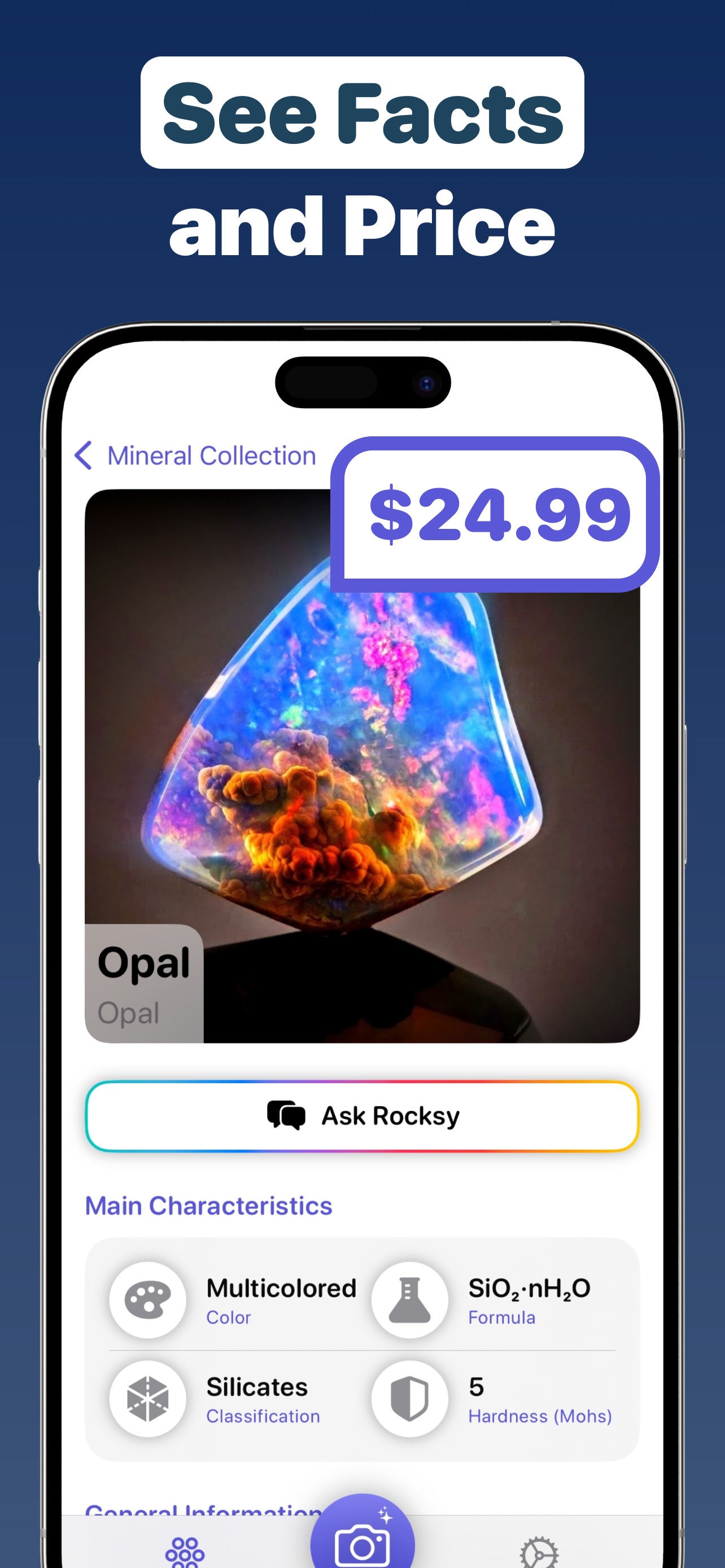
Mineral Identifier AI includes built-in price estimation: identify a stone from a photo and the app displays an approximate market value alongside the mineral's name and properties. It's the quickest reality check available before buying, selling or trading.
Check what your rock is worth with Mineral Identifier AI
- Download Mineral Identifier AI free on iPhone or iPad.
- Scan your rock with the camera — good light and a sharp close-up give the best results.
- See the value tag: the result screen shows the identified mineral with an estimated market price (like $24.99 for a small opal).
- Review the properties that drive that price — color, hardness, classification — so you understand why.
- Save it to your collection to build a running record of your finds and their estimated values.
Rough value ranges to calibrate expectations
Most rocks people find are common quartz, feldspar or calcite worth a few dollars at most — but that's exactly why scanning matters: the exceptions hide among them. Tumbled crystals typically sell for $2–$15; nice mineral specimens for collectors run $20–$200; and rare finds — fine opal, high-grade turquoise, gem-quality crystals, meteorites — can reach thousands. An instant estimate tells you which shelf your stone belongs on.
When to get a professional appraisal
Treat the app's estimate as a smart starting point, not a certified valuation. If a scan suggests you're holding something unusually valuable, photograph it from several angles, avoid cleaning or polishing it, and take it to a gemologist, a natural history museum, or a local gem and mineral society for confirmation.